● The Academy Model

A 6×6 floor.
Eight revenue streams.
Documented unit economics.

The Academy Model is the business architecture underneath the Light Sword combat license. Not a school, not a venue, not a franchise. A structured business architecture that produces academy tuition, league revenue, drop-in conversion, sponsor income, and merchandise margins from a single 36-square-foot training floor. This page is the architecture and the math.

Read It All for $197 Which Path Fits
See the Numbers ↓ License the Program → Get In Touch
Network Operators Active · the U.S. and Internationally · U.S. Military Installations · Founded 2015

Architecting a 70% margin.
The unit economics walked through.

The architecture and the P&L walked through directly. (Recorded under the earlier royalty-based structure. The current flat-fee model below nets higher.) Watch this first if you're short on time. Read the deep architecture below if you're evaluating closely.

What The Academy Model
structurally is.

A traditional martial arts school is a single-revenue-stream business. Tuition. Sometimes a pro shop in the corner. The unit economics are constrained by class size, teacher capacity, and the difficulty of converting trial students to long-term members. The product is fundamentally a service, and services don't scale linearly.

An entertainment venue: a TopGolf, a Dave & Buster's, a competitive socializing concept, is the inverse. Capital-intensive build-out, $4-15M in fit costs per location, real estate exposure, but high revenue per square foot when the format works. The unit economics scale, but the capital wall keeps the operator pool small.

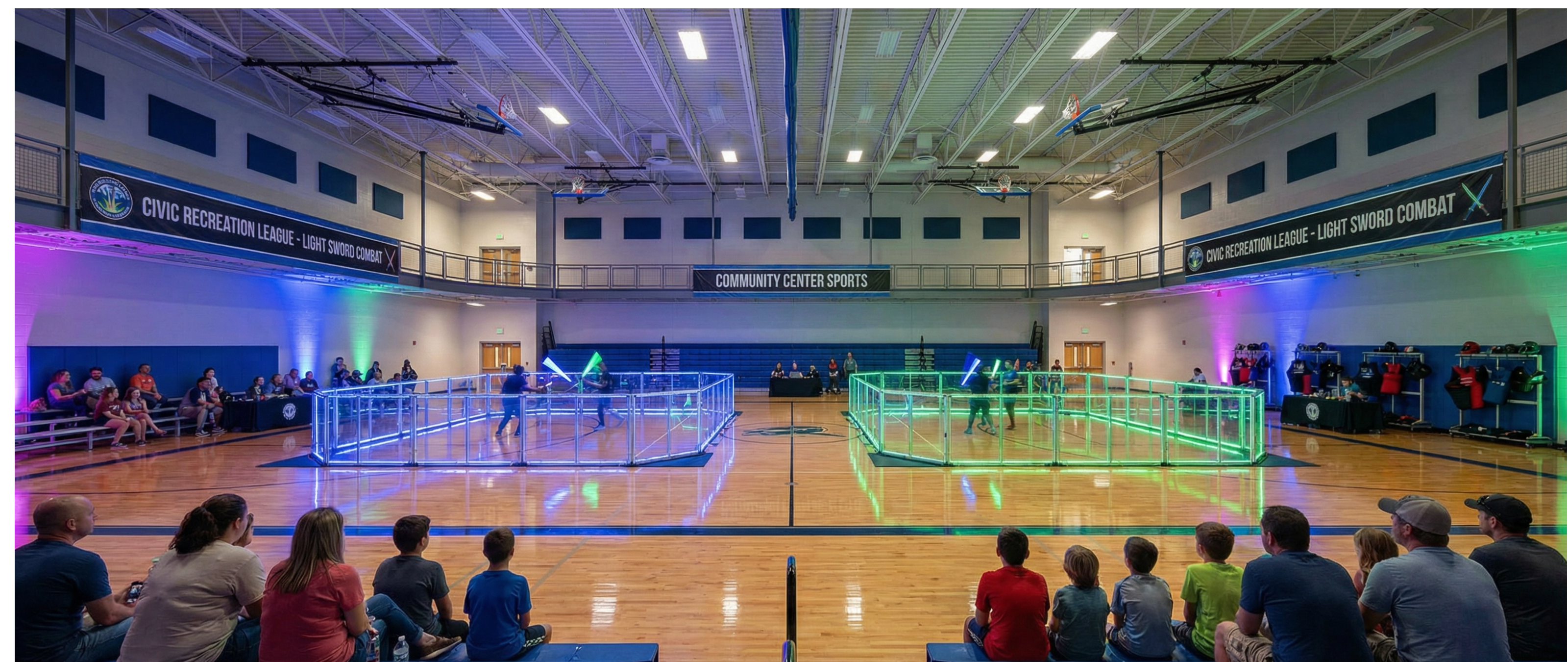
The Academy Model structurally combines both sides. The academy side produces the recurring tuition revenue and rank-progression retention of a martial arts school. The league side produces the per-event high-margin economics of a competitive entertainment venue. Both sides run on the same physical floor: a city rec center gymnasium that the operator does not lease, build, or maintain.

The result is a model with the recurring revenue of a martial arts school and the per-event economics of a venue, with neither's capital requirement. The operator's out-of-pocket capital is the licensing fee plus working capital. There is no comparable structure in either category.

Martial Arts School
Single revenue stream. Constrained by teacher capacity.
Entertainment Venue
High margin per event. $4–15M fit-out per location. Capital wall blocks most operators.
The Academy Model
Both sides on one floor. No lease. No buildout. Recurring + per-event revenue. License fee is the only capital wall.

Eight revenue streams.
One 6×6 training floor.

No single-stream business survives a recession. The Academy Model is built on eight independent revenue streams that compound on the same physical infrastructure. Below: each stream, what drives it, and what it produces at mature operation.

Stream 1
Academy Tuition
$11.6K–$23.6K/mo
$97–$197/mo per enrolled student. 120 students at full capacity. Recurring monthly revenue, 9-sash rank progression drives retention. The bedrock revenue stream.
Stream 2
Saber Tag League
$49K+/season
$247/player/season × 200+ participants per season. 3–4 seasons per year. Tournament-format competition with electronic scoring and national rankings. Highest per-customer revenue stream.
Stream 3
Drop-In Day Pass
$2.8K+/month
$25/session × 30+ walk-ins per Saturday Day Pass event. 80% of Norfolk drop-ins convert to paid enrollment within 60 days, the Conversion Bridge feeding stream 1.
Stream 4
Private Lessons
$1.6K+/month
$80/hour × 20+ private sessions per month. High-margin instruction for individual students who want accelerated rank progression or competition prep.
Stream 5
Birthday Parties & Events
$2K+/month
$350–$650 per booked event. 4–6 events/month at mature operation. Low-effort revenue using the same floor on Sunday afternoons. Strong gateway to stream 1 enrollment.
Stream 6
Sponsor Revenue
$14.8K–$16K/year
Three-tier sponsor program ($3K / $7K / $14.8K–$16K). Local sponsors fund equipment and league operations in exchange for visibility at events. Three sponsor slots per academy.
Stream 7
Pro-Shop & Merchandise
$800+/month
Sash sales, limited-edition saber designs, branded apparel, training gear. Margins of 45–60%. Volume scales with student count and league participation.
Stream 8
Rank Test Fees
$1.2K+/quarter
$45–$95 per rank examination. Roughly 30–50 rank tests per quarter at mature operation. Direct revenue from the rank progression that already drives retention.
Mature Operation Total
~$481K Gross / ~$341K Net Annual (Illustrative)
120 enrolled students · 200+ league participants · 4 events/month · 3 sponsor slots filled. ILLUSTRATIVE. Modeled on the Norfolk academy operating at full capacity. Individual results vary.

What one academy's P&L
actually looks like.

A mature academy running The Academy Model at full capacity. Numbers reflect the Norfolk academy and the cohort operating at scale.

Annual P&L · Mature Operation · 120 Enrolled + 200 League
Revenue
Academy tuition (120 students avg $147/mo)$211,680
Saber Tag league (3 seasons × 200 players × $247)$148,200
Drop-in day pass + birthday parties + events$57,600
Private lessons$19,200
Sponsor revenue (3 slots filled)$26,000
Pro-shop, merchandise, rank fees$18,720
Gross Revenue$481,400
Operating Costs
LSTA platform fee (flat $285/mo, no royalties, no % of gross)$3,420
Rec center facility share (20% of league + drop-in)$41,160
Equipment maintenance + replacement reserve$18,000
Insurance + liability + admin$14,400
Marketing + community outreach$12,000
Coach compensation (1 PT instructor)$32,400
Software, platform & payment processing$19,000
Total Operating Costs$140,380
Net Annual Profit (Illustrative)
~71% projected margin at full capacity, flat-fee license structure, no royalties
$341,020
Note on year 1 vs mature operation
ILLUSTRATIVE YEAR 1 EXAMPLE: Year 1 typically reaches ~30–60% of these numbers. The 15-student launch commitment in the Partner License is structured around Year 1 ramp. Mature operation (Year 3+) is the steady-state target. Conservative operators often plateau at 60–80 students and ~$150K net. Still a viable single-operator business by every reasonable standard.

Why this scales where
other models can't.

The structural advantages that make The Academy Model replicable. Each is a deliberate architectural choice, not an accident of circumstance.

No Lease
City rec centers provide the floor.
Standard arrangement: 20% revenue share, $0 in upfront facility cost. No commercial lease, no build-out depreciation, no real estate exposure. The single largest fixed cost in any martial arts school is removed entirely.
No Buildout
Equipment fits in the operator's vehicle.
A complete Saber Tag X-Treme equipment kit: sabers, electronic scoring system, helmets, vests, court tape, fits in a standard SUV. Setup: 25 minutes. The "venue" is the operator's vehicle plus a city gymnasium. Fit-out cost: zero.
No Expertise Required
The operator is not a martial artist.
Curriculum delivery, rank progression, form correction. All handled by the WISE operating system and Shadow Council instructors via video review. The operator runs the business; the system runs the training. This separation is what makes the model replicable.
First-Mover Category
The category is wide open in nearly every market.
In nearly every U.S. market, no other Light Sword combat program exists yet, the operator who moves first defines the space.
Conversion Bridge
Documented 80% drop-in to enrollment.
$25 Saturday Day Pass walk-in → 4-step Conversion Bridge script → paid academy enrollment. Documented at the Norfolk academy at ~80% conversion. This is the demand engine for stream 1 (academy tuition), and it's a system, not a sales pitch.
Rank Retention
9-sash progression locks long-term enrollment.
Students don't cancel mid-rank. The 9-sash, 3-level system creates a 3–5 year visible progression path with documented advancement criteria. Average student lifetime runs well past the industry's commonly cited 6–9-month norm.

WISE, Warrior Intelligence System Edge.
The infrastructure underneath.

Every revenue stream depends on the same four-layer operating system. WISE is what separates The Academy Model from a martial arts school with a side hustle.

WISE, TRAIN
Master-Coached Form Review

Students submit form videos; Shadow Council instructors return personal critiques within 72 hours. Real coaches, at scale, not algorithmic feedback. Want to become one of those instructors? See the Program Instructor path →

WISE, WELLNESS
LSTA Wellness Platform

Recovery, nutrition, and performance tracking between sessions on the AcadevoFit app. Members stay engaged seven days a week, not just on training nights. Direct retention driver.

WISE, COMPETE

Century Martial Arts-backed electronic scoring. Every match feeds national standings. Public rankings create a permanent reason to stay in the league.

WISE, CURRICULUM
12-Volume Academy System

Complete operations playbook: enrollment, events, sponsorships, community, scaling. Plus the AcadevoFit Martial Arts Pro lead-capture and member-management platform. The curriculum is the business.

Full WISE breakdown lives on the Partner License page. See the deep dive →

Operationally validated
before it was offered.

Every historical claim on this page is drawn from real operations, and every forward-looking dollar figure is clearly labeled illustrative. The model isn't theoretical. It's in production at a federation-registered network across the U.S. and internationally, and at U.S. military installations LSTA has partnered with.

See the three documented deployments →

2015
The founding academy opened in Virginia Beach. The Norfolk academy followed in 2019. Every system was tested on those floors before any license was sold. Operationally validated for over a decade.
Network
Active operators in production across the U.S. and internationally. Across all three license tiers. The model has been replicated outside Norfolk successfully.
Federal
U.S. military installations LSTA has partnered with to train active-duty personnel, including Langley AFB and Fort Eustis. Federal contract validation.
1,500+
Warriors trained through the system since founding. 60+ five-star reviews across all locations. The student-side proof of curriculum quality.
Built by people who've already won at the highest level. Sifu Edward Armstrong (Entrepreneur of the Year; Board-Certified Tai Chi Instructor; Spring Forest Qigong L3). Sijo Nathan Young (2× World Champion). Sifu Julliana Armstrong (3× WEKAF National Champion). Sifu Nick Benseman (founding master instructor & Hollywood stunt director). Same team that designed the system teaches inside it.

Now that you understand the model.

That is the model. There are two paths from here. Depending on whether you're ready to operate or still evaluating.

If You're Ready to Operate
Pick a tier. Book the call.
Three license tiers fit three different operating lives. The hub page compares all three with a 30-second decision tool.
License the Program →
If You're Still Evaluating
Talk to someone who runs one.
Schedule a conversation with our team. A financial projection for your population size and a straight answer on whether the model fits your situation.
Get In Touch →
Want to read the deep architecture first? Partner License deep-dive →

Earnings disclaimer: Any income, revenue, margin, or retention figures on this page. Including monthly/annual revenue ranges, net margins, and percentages. Are documented results from our founding operations or illustrative examples. They are NOT typical results, projections of your results, or guarantees of any kind. Individual results vary widely with market, effort, pricing, and execution; many will earn less and some will earn nothing. We make no guarantee of any specific financial result.