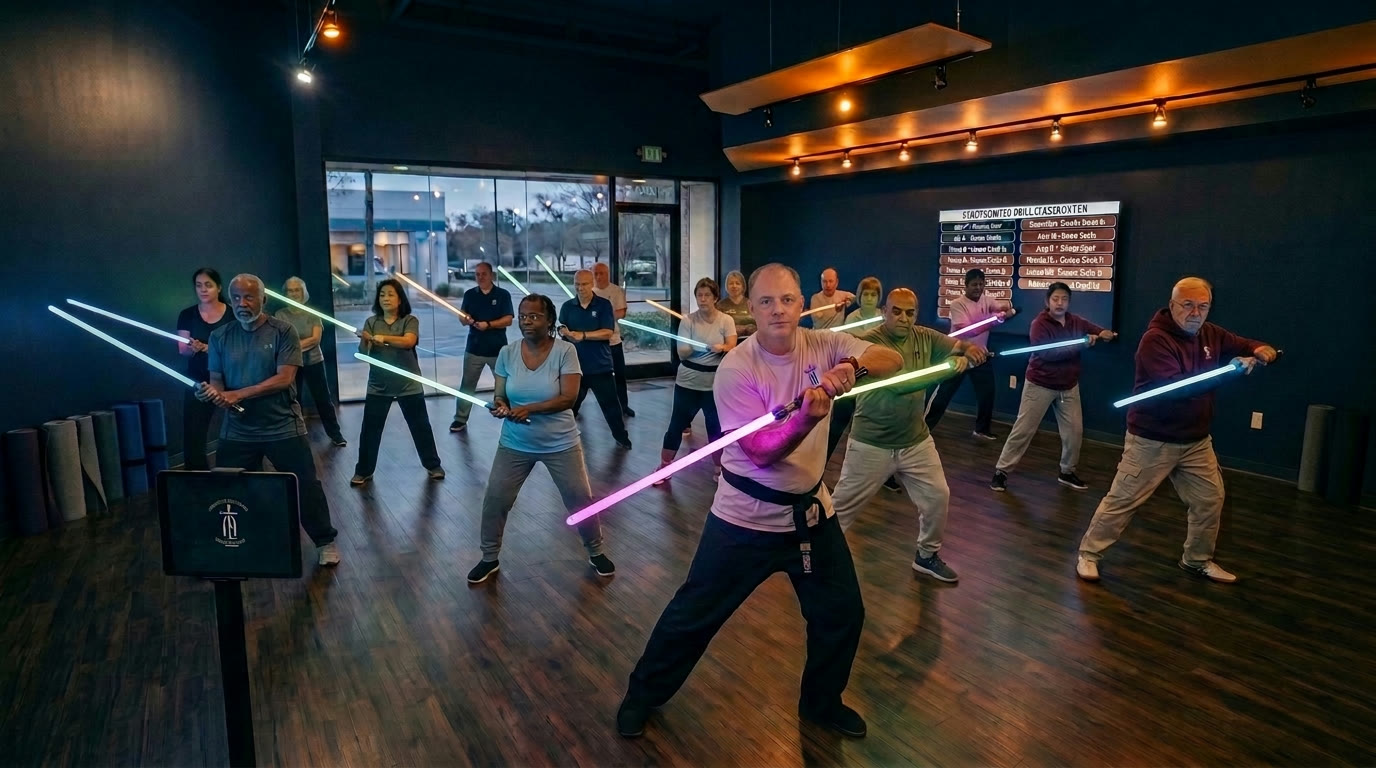
Same art. Same room.
Same phone call.
Two school owners in two Connecticut towns. Same rent, same size floor, same nine years of kids at four, teens at six and adults at seven. In the same week, both got the same call: a woman asking whether they had anything for her husband. He had just been diagnosed with Parkinson's. His neurologist said to keep moving. The boxing program forty minutes away was too hard for him, and the chair class at the senior center felt like giving up.
The first owner
Said, honestly, "I'm sorry, we don't have anything like that." Hung up. Kept teaching the schedule he had always taught. The floor stayed dark from ten to three every day, and the woman's husband stopped going out.
The second owner
Said, "Tuesday and Thursday at ten. Bring him, and come yourself." Eight weeks later there were eleven adults on the floor at ten in the morning, two neurologists' offices knew the school's name, and the owner had taught the whole thing alone without touching a single evening class.
Eight things that change
on your floor.
Everything below is written for the person who owns the school and teaches the classes. If that is you, read it as a list of what changes on Tuesday morning.
Paying adults at ten in the morning
Studios trough from ten to three at a fraction of their evening peak. A cohort fills two of those hours a week with adults who were never coming to your seven o'clock.
A second adult line that never touches your evenings
No displaced class, no new floor, no second instructor. You teach it yourself in the slot that was earning nothing, and the flat fee means what the cohort earns stays with you. No royalty, ever.
A program you can still teach at sixty
Both programs are slow, breath-paced and seated-capable. Your knees are not the limit on this one, and neither is your calendar age.
The school the doctors know by name
The referral playbook shows you how to become the place movement-disorder clinics, physical therapists and support groups send people. Nobody in most towns runs the gentle middle between boxing and the chair class. You will.
Retention by design, not by nagging
A cohort has a start date, a cap, a waitlist and a partner seat. People who signed up for eight weeks with their spouse do not drift at month six.
Your own students, for life
Every school loses adults who can no longer take the intensity. A movement program is the off-ramp that keeps them in your building and in the art, at the pace their body has now.
Launched, not invented
The sales page, the schedule, the intake and clearance forms, the cohort calendar and the partner policy arrive done, built from the first cohort in Norwich. You put your name on them and open a sign-up day.
A credential that can be checked
LSTA Corporate is the only body that certifies instructors in this system. Your name goes on the Saber Kinetics instructor register, and you run the program under your own school's brand with a lineage a clinic can look up.
Two numbers you already know,
and two you should.
The people who could fill your daytime hours are not teenagers. They are the adults over fifty who were told by a doctor to stay active and then found nothing built for them.
10 to 3
The daily trough. Studios run near a quarter of evening peak in those hours. Gym-platform utilization summaries; directional estimate.
60 to 70%
Average martial arts school retention, against 75 to 85 needed for durable profit. Industry benchmark reports.
1 in 6
Americans is 65 or older, and the share rises every year. U.S. Census Bureau, 2020.
1 in 5
U.S. adults reports chronic pain; 32.5 million live with osteoarthritis; close to 1.2 million with Parkinson's. CDC; Parkinson's Foundation.
Here is what those adults are offered today. High-intensity boxing programs, excellent for the ones who can still take a hard hour. Free chair classes at the senior center, which end with the grant that funded them. Physical therapy, which works and then runs out. Nothing in the middle: slow enough for a stiff morning, structured enough to keep, and dignified enough to bring a spouse to.
The research keeps pointing at that middle. Twice-weekly tai chi produced better balance and fewer falls than stretching in a 195-person Parkinson's trial (Li, New England Journal of Medicine, 2012). The 2019 American College of Rheumatology and Arthritis Foundation guideline strongly recommends tai chi for knee and hip osteoarthritis, and a 2016 trial found it as helpful as physical therapy for knee pain (Wang, Annals of Internal Medicine). A 2010 trial found the same for fibromyalgia (Wang, New England Journal of Medicine).
The nine forms,
slowed to a therapeutic register.
Saber Flow takes the nine forms of the Light Sword Training Academy curriculum and slows them to a pace a recovering body can use. The light sword becomes a weightless prop: something to extend through, to track with the eyes, to organize movement around.
A martial art
No sparring, no impact, no intensity curve. The combat application is set aside entirely; only the movement remains.
Medical treatment
It sits alongside a physician or physical therapist and never replaces them. That is exactly why a school can run it and a clinic will refer to it.
A movement practice
Guided, repeatable, restorative. Sixty minutes, twice a week, in a small cohort, with a chair at every spot and a seated path for every form.
Five modules,
each one a thing you no longer have to figure out.
Self-paced, most instructors finish in three to four weeks, teach-back review in week five, first cohort the month after.
So you can teach it on day one: the curriculum
All nine forms at the therapeutic register, every form's seated path, the four principles, and how to adapt a form to a tremor, a replaced knee or a bad morning.
So it fills and stays full: the cohort model
Eight weeks, sixteen sessions, a sign-up day, a cap set to your room, a waitlist, and the partner seat.
So you never cross a line: safety and clearance
The intake, the doctor's clearance form, the chair-at-every-spot rule, and where a movement practice ends and medical treatment begins.
So the town sends people: the referral playbook
Who in your county already serves this population and how to become the place they send people, with scripts and a one-page referral sheet.
So you launch next month: the kit
The cohort sales page, schedule template, intake and clearance forms, cohort calendar and partner-seat policy, ready to put your name on.
So it can be checked: LSTA Saber Flow Instructor Certification
Issued by LSTA Corporate after your teach-back review. Your name on the Saber Kinetics instructor register.
The moving-meditation
instructor path.
Saber Chi is the second Saber Kinetics program on this page: a moving-meditation practice built on the same lineage, licensed the same way.
Foundation Level Certification, $2,997
Level 1 Saber Chi Basic instruction qualification. A 40-hour intensive training program covering comprehensive teaching methodology, plus business development support to launch your own cohort.
Levels Above Level 1
Levels 2 through 10 are by personal invitation only, the same pattern as every LSTA instructor path on this page. Master instructor recognition and academy partnership opportunities open from there.
Built by a school owner,
for his own empty mornings.
You have probably never heard of us. Here is exactly who we are, and every claim below can be checked.
The owner
Keith Nye runs Saber Core Light Sword Academy in Norwich, Connecticut, alone, on a floor he shares with a karate school. He co-founded Saber Flow with Sifu Edward Armstrong because his own floor was dark until four and his own town kept calling.
The lineage
Saber Flow was co-founded by Sifu Edward Armstrong and Keith Nye. Saber Flow and Saber Chi are two of the four programs of Saber Kinetics, the wellness licensing division of the Light Sword Training Academy. Sifu Edward Armstrong is a Board-Certified Tai Chi Instructor and a Spring Forest Qigong Level 3 Practice Group Leader; the approach draws from those traditions, used for relaxation, stress reduction, balance and wellbeing.
The academy behind it
The Light Sword Training Academy has held federal contracts at U.S. military installations and has trained 1,500+ warriors across a federation of network academies since 2015. The studies cited on this page are cited by author and journal.
Three ways to run a program
in your community.
The founding instructor cohort is capped at 100 instructors, the standard cap on every LSTA founding offer, so every teach-back is reviewed by a person. Flat fee. No royalty. No territory. Credits stack toward any LSTA license upgrade.
30 days, unconditional.
Take the course. If within 30 days you decide it is not for your floor, email us and we refund it in full. No form, no call, no pitch to stay.
What this is not: a promise of income, enrollment or clinical results. Your cohort's results depend on your floor, your town and your work. Individual results vary.
Saber Flow Instructor Course
Certification to run Saber Flow cohorts under your own brand.
- Modules 1 to 5 and the launch kit
- Teach-back review and LSTA certification
- Instructor register listing
- Light Sword Field Instructor? Your $797 credits in full: $2,200
Saber Chi Foundation Certification
Level 1 qualification to run Saber Chi cohorts under your own brand.
- 40-hour intensive training program
- Comprehensive teaching methodology
- Business development support
- Light Sword Field Instructor? Your $797 credits in full: $2,200
Saber Flow Program License
For certified instructors who want the platform under the program.
- AcadevoFit deployment under your brand
- Scheduling, billing, intake and progress tracking
- Cohort page hosted and updated
- Requires the Instructor Certification
Five fields.
A person reads it.
Tell us about your floor, your town, and which program you want to teach. We reply within one business day with the founding-cohort details and the next start date. Applying does not reserve a seat.
What school owners
ask first.
Is Saber Chi the same as Saber Flow?
No. Both are Saber Kinetics moving-practice programs licensed the same way, at the same Level 1 price, but they are different curricula. You can hold either certification, or both.
Do I need a medical or clinical background?
No. You need to be an instructor already: martial arts, fitness, yoga, tai chi, or a movement professional. The course teaches the clearance protocol and the line you never cross. It does not make you a clinician.
Is this the same as the LSMA Instructor Certification?
No. The LSMA Instructor Certification certifies you to teach the Light Sword combat system. The Saber Flow and Saber Chi courses each certify one Saber Kinetics wellness program. Your $797 Light Sword Field Instructor fee credits in full toward either, the same way every LSTA credit stacks toward an upgrade.
Is there a royalty or a revenue share?
No. Every LSTA license is a flat fee with no royalty and no revenue share. What your cohort earns is yours.
What is the partner seat?
Every Saber Flow cohort includes a seat for the participant's spouse, partner or driver at no charge. It is a program standard, not an option.
How long does the course take?
Self-paced. Most instructors complete the modules in three to four weeks and schedule the teach-back review in week five.
Which owner will you be?
Both got the same call. One had an answer, and his floor is full at ten in the morning. Join the founding instructor cohort and be the school your town's doctors know by name.